
Smart Factory
The connected factory – level by level
Our model factory shows how robots, sensors, controllers, supervisory systems and the cloud work together. Four perspectives: the communication levels, the factory campus, the production hall and the next robot generation.
Communication levels of robotics
Five levels of connectivity – from the sensor on the robot to the cloud
The automation pyramid as an isometric model factory: each level delivers data upwards and receives targets from above.
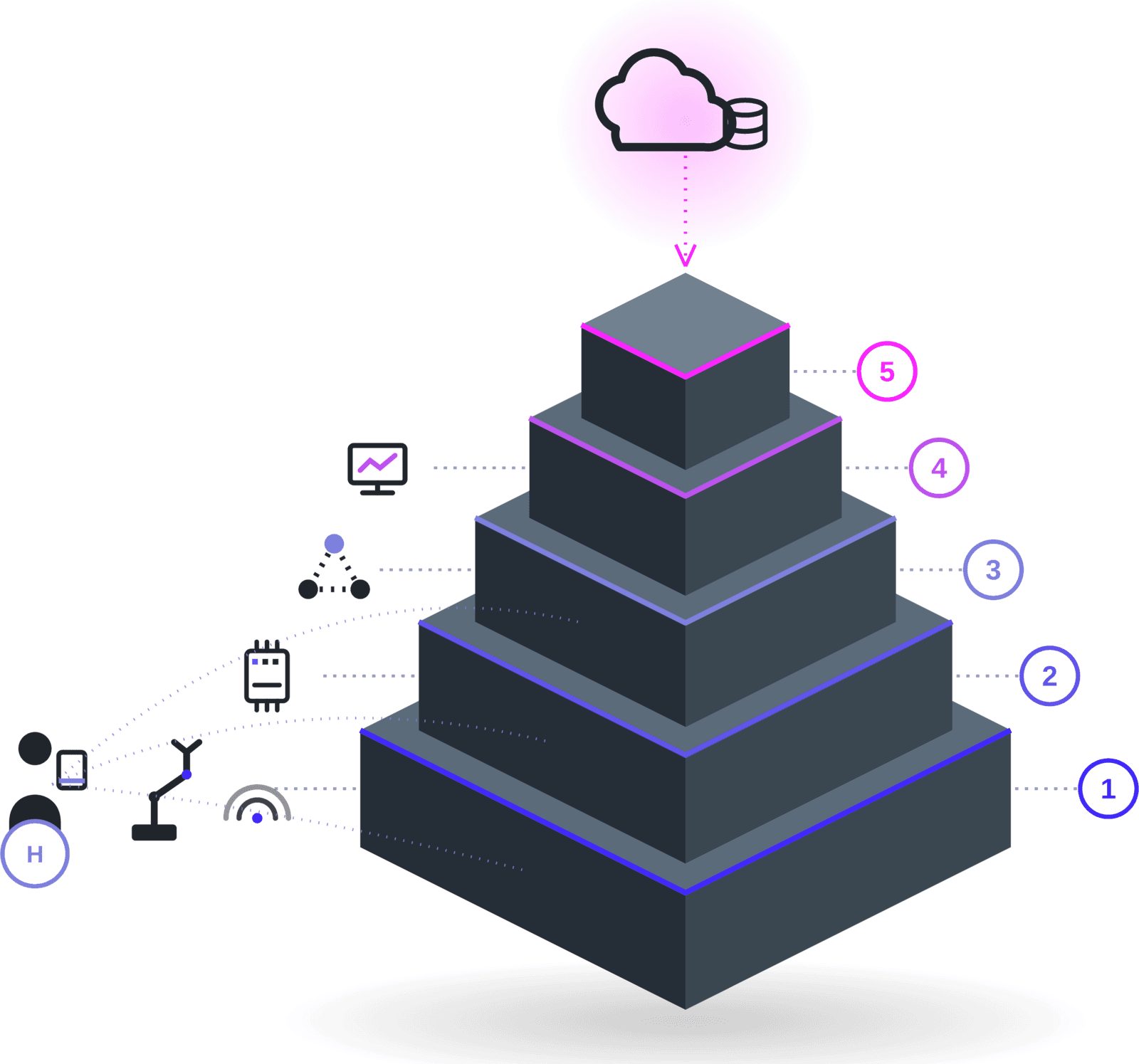
ERP / cloud level
Links production data with business processes, analytics and remote maintenance.
MES / supervisory level
Consolidates production orders, quality and plant data across the whole production.
Robot-to-robot communication
Robots exchange status and coordination data directly, e.g. for collision-free path planning.
Control level
Robot controllers and PLCs process sensor data in real time and issue motion commands.
Field level
Robots, sensors and actuators capture and control the physical process directly at the machine.
Cross-cutting: human-robot interaction
Operators monitor and access the field, control and communication levels via HMI and tablet.
Principle of the smart factory
The connected factory campus
From the machine via the campus network to the digital twin – a closed data loop.
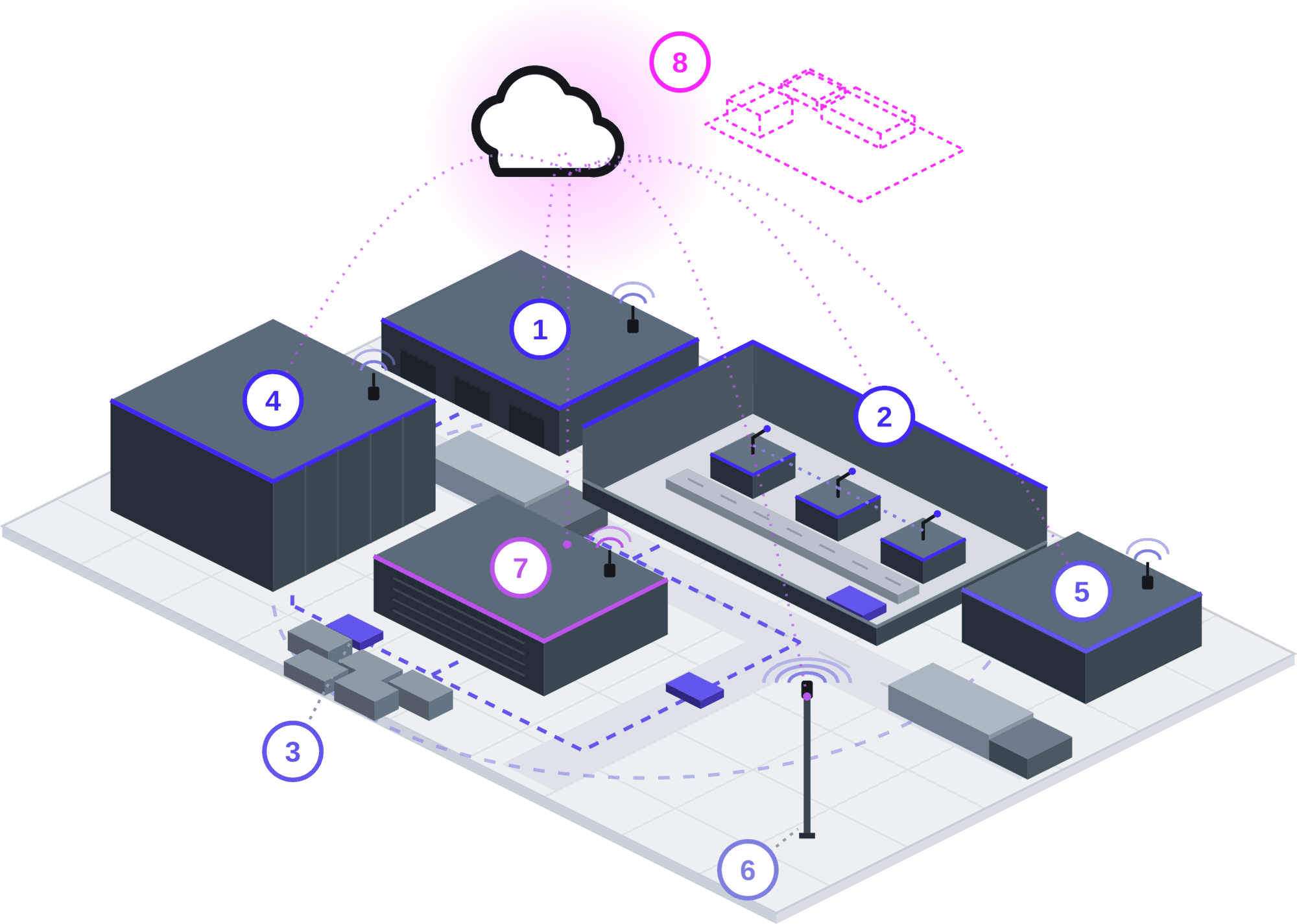
Goods receipt & shipping
Scan and RFID capture, digital dock and route control.
Production hall with robot cells
Robots exchange process and status data in real time.
Intralogistics (AGV / AMR)
Autonomous transports connect warehouse, production and shipping.
High-bay warehouse
Automated storage and retrieval, stock levels live in the system.
Inline quality inspection
AI image processing inspects parts directly in the line.
5G campus network & IoT sensors
End-to-end connectivity across the entire site.
Edge data centre & control room
Local data processing, MES, bridge between OT and IT.
Digital twin in the cloud
Simulation, AI analytics and planning on the complete data set.
The loop behind every level
- 01
Capture
Sensors, machine and logistics data
- 02
Connect
5G campus network, OT/IT integration
- 03
Analyse
Digital twin, AI models
- 04
Control
Feedback into plants and robots
Zoom-in
Production hall with connected robot cells
What happens in the hall – and which data each cell delivers upwards. Safety zones in blue, collaborative zone in violet.
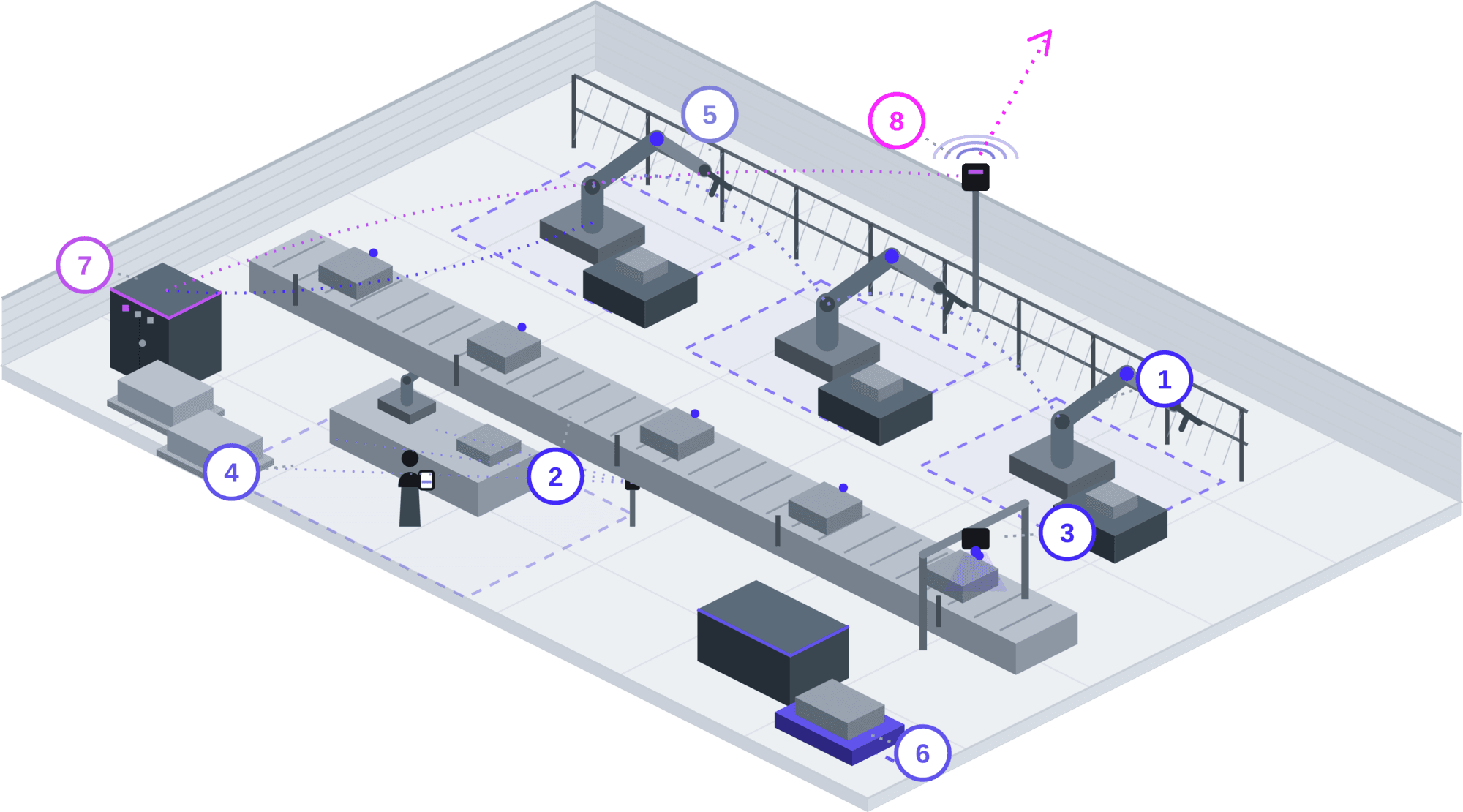
Six-axis robots
Gripping, joining, screwing in a cycled process.
Workpiece flow with RFID
Every part identified and traceable in cycle.
Inline vision inspection
Camera portal inspects in cycle, AI evaluates deviations.
Collaborative workstation with cobot
No fence: laser scanner monitors the safety zone.
Robot-to-robot coordination
Cells synchronise cycles and handovers directly.
AMR docking station
Material replenishment drives autonomously to the cell.
Cell controller / PLC
Real-time control, fieldbus to robots and sensors.
Edge gateway to MES & twin
OPC UA / MQTT delivers cell data upwards.
Principle: every cell generates cycle, quality and condition data. The cell controller regulates in real time, the edge gateway lifts the data into MES and digital twin – results flow back into the cell as new parameters.
Next robot generation
Humanoid and quadruped robots in production
Mobile robot generations complement fixed automation – orchestrated via the same data platform.
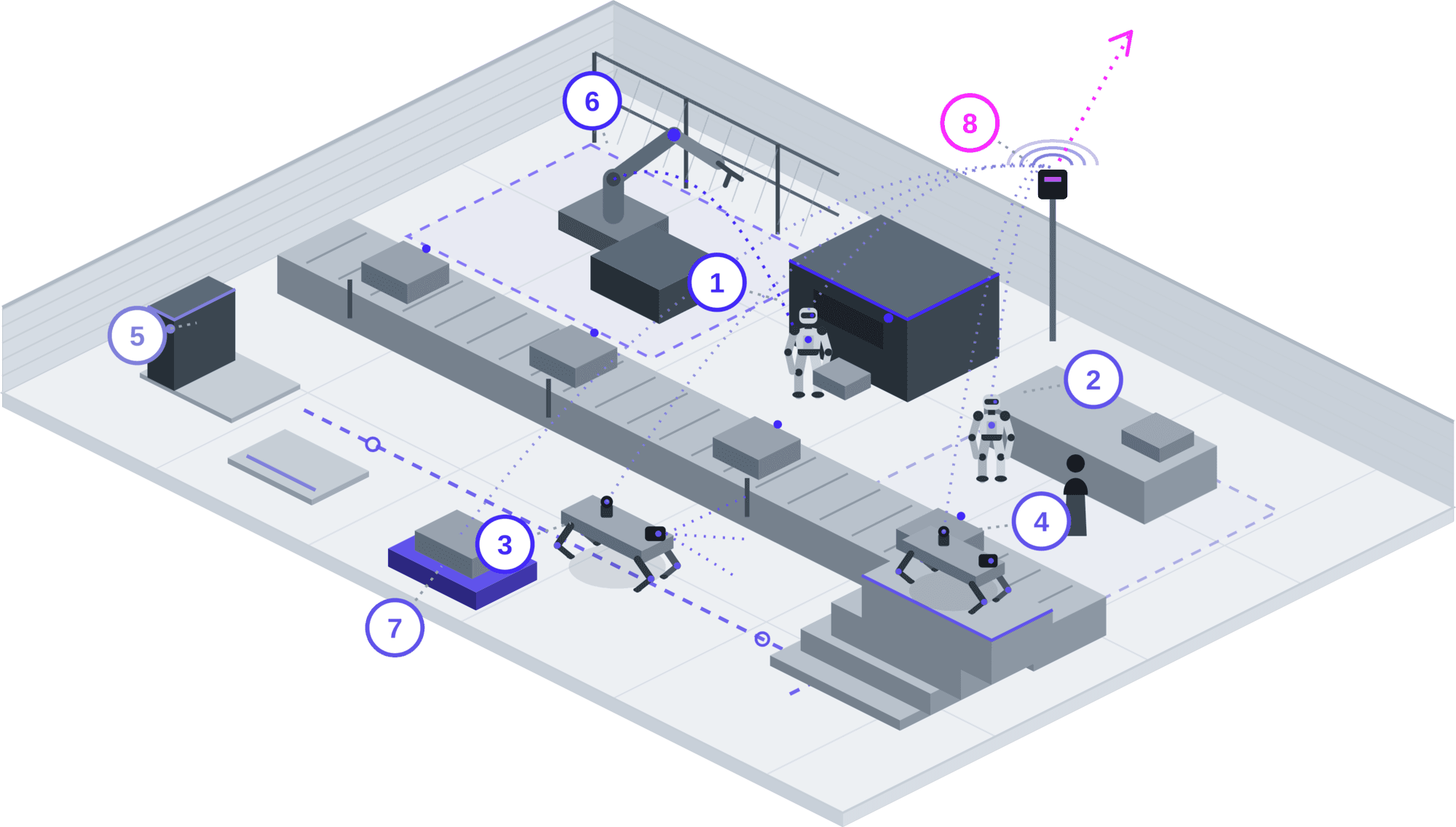
Humanoid at the machine
Operates existing plants without rebuilding the cell.
Humanoid in the collaborative team
Takes over feeding and inspection next to the worker.
Quadruped robot for monitoring
Autonomous inspection route with sensor payload.
Access via steps and platforms
Reaches elevated areas without modification.
Charging stations
Humanoids and quadrupeds dock autonomously.
Existing robot cell
Fixed automation remains the foundation.
AMR fleet
Autonomous transports handle the material flow.
Fleet orchestration & edge AI
Orders distributed dynamically, data into the twin.
Principle: humanoids take over tasks at plants built for humans; quadrupeds inspect areas no fixed sensor covers. Both hang on the same fleet orchestration as AMRs and robot cells – and deliver their data into the same digital twin.
How connected is your factory today?
We analyse your levels, interfaces and data flows – and show where robotics and AI enable the next step.